

A Seattle car accident lawyer can help preserve evidence, assess fault and insurance coverage, and document the losses caused by a crash. Bernard Law Group reviews collision reports, medical records and witness information to explain your options. Many Washington injury lawsuits have a three-year filing period, but exceptions and public-entity procedures can change the timeline.
Request a free consultation | Call (206) 298-9900
Bernard Law Group – Seattle Accident Attorneys
900 Aurora Ave N Apt 100
Seattle, WA 98109
Tell us when and where the collision happened, what injuries you have and whether an insurer has contacted you. You can request a consultation while a report or medical records are still pending.
Explore: Our team | First steps | Reports | Insurance | Deadlines | Fees | Results | Office | FAQs
Our published case results include a $720,000 rear-end collision settlement involving back surgery and lasting work limitations. The published description does not identify the crash as a Seattle case. Past results do not guarantee future outcomes.
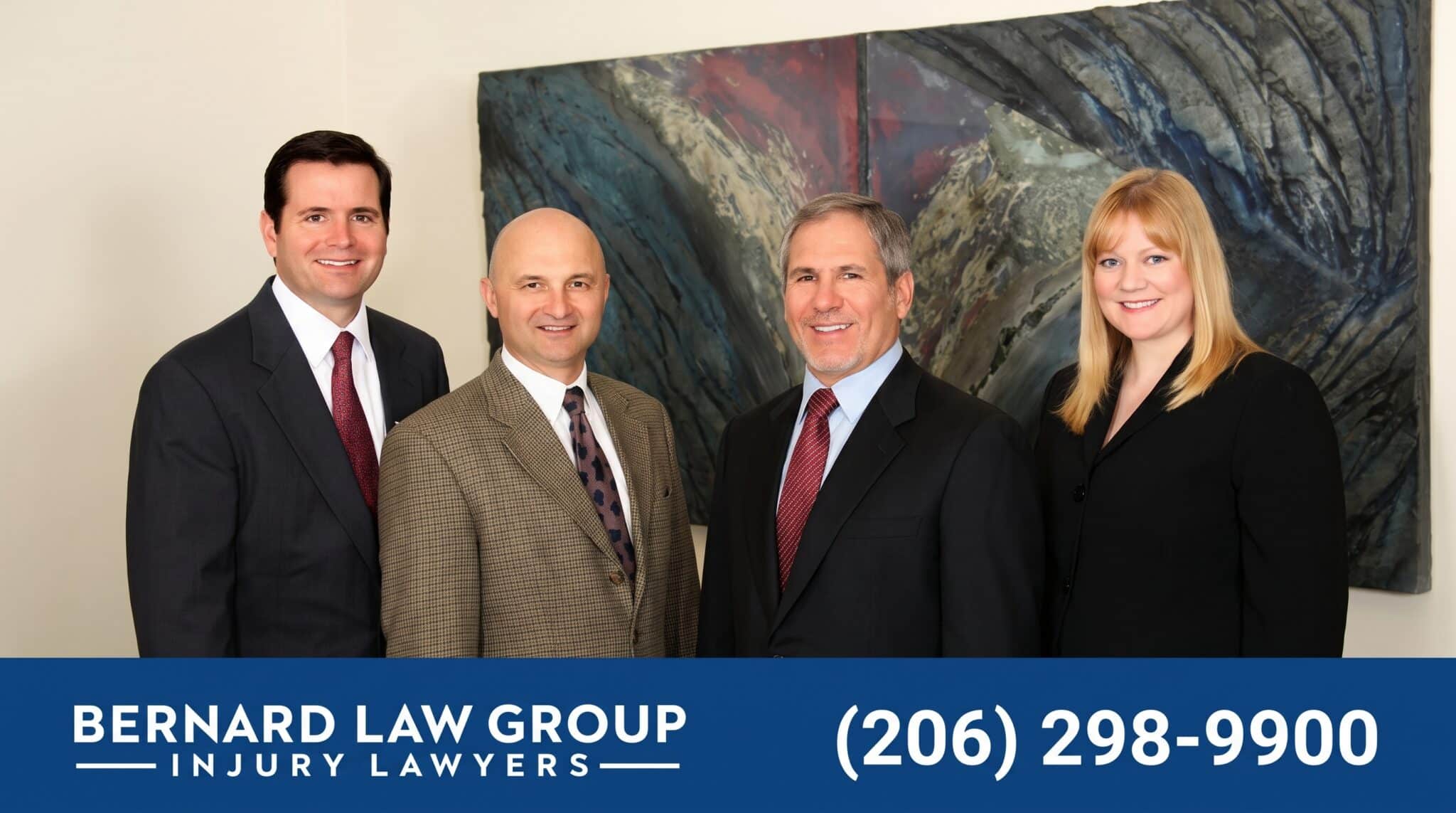
Meet Your Seattle Legal Team
Learn about the attorneys at Bernard Law Group and ask who would oversee your car-accident matter. The consultation is an opportunity to discuss relevant experience, communication and the work your claim may require.
- Kirk Bernard — Founder. View his professional background and published case experience.
- Viivi Vanderslice — Personal Injury Attorney. Her background includes representing insurance companies before focusing on injured people.
- Megan L. Wernli — Attorney. Read her biography and discuss which experience is relevant to your collision.
Meet the full legal team. Case assignment depends on the matter and the representation agreement. If we accept your case, the written agreement explains the representation before you sign.
What should you do after a Seattle car crash?
Protect your health first. Then preserve information and identify any urgent reporting or insurance requirements.
- Get to safety and call 911 for an emergency. Follow responders’ directions and seek medical evaluation for your injuries.
- Exchange and save information when safe. Keep driver and insurance details, witness contacts, photographs, the crash location and the responding agency’s report number. Do not put yourself in traffic to collect evidence.
- Keep treatment and financial records. Save bills, work restrictions, missed-work information and a short record of symptoms or daily limitations. Explain treatment barriers to your provider.
- Notify your insurer and review requests. Check policy notice and cooperation duties. Understand requests for recorded statements, broad medical authorizations or releases before agreeing; a release can give up further compensation.
How do you get the collision report?
Start with the agency that investigated and the type of record you need. A road name alone does not identify the responding agency, and a police report does not resolve every issue of fault.
- Seattle Police records: Follow SPD’s Front Counter Services guidance for collision reports and the Public Records Request Center route for more detailed records, including available audio or video. Keep the incident number and check identification requirements.
- Statewide collision reports: Washington State Patrol’s WRECR search provides access to collision reports held by WSP, including reports from other Washington agencies. It is not limited to crashes investigated by state troopers.
What if no officer completes a report?
Under RCW 46.52.030, drivers generally must submit a written report within four days after a qualifying collision if no law-enforcement report will be made. Qualifying crashes include injury, death or apparent damage of at least $1,000 to one person’s property. Use WSP’s civilian reporting instructions and OMVCR tool and retain a copy. An insurance claim is a separate step.
Availability and processing depend on the record and investigation. Save your own evidence while waiting; missing paperwork need not delay a consultation.
What kinds of car collisions do we review?
Different crash patterns raise different evidence and coverage questions. Explore rear-end collisions, Uber accidents and hit-and-run claims. We also review intersection, head-on and multi-vehicle crashes, including injuries to passengers.
Distraction, impairment, unsafe speed and failure to yield may be relevant, but each allegation needs evidence. Higher speed can increase stopping distance and impact severity; it does not by itself establish all elements of a claim.
What insurance may cover medical care or a hit-and-run?
The available policies and their terms determine which claims may be possible. Bring your declarations page, insurance correspondence and any claim numbers to the consultation.
- Personal injury protection: PIP coverage can help with qualifying medical costs, lost income and certain other expenses regardless of fault, subject to limits and exclusions. Washington insurers must offer PIP, but a policyholder may reject it in writing.
- Uninsured or underinsured motorists: UM/UIM coverage, if included in your policy, may apply when another driver has no insurance, insufficient coverage or leaves the scene. Hit-and-run and unidentified-vehicle claims can have prompt reporting requirements; ask about these immediately.
- Other coverage: Another driver’s liability policy, your collision coverage, health insurance or an employer’s or rideshare policy may be relevant. Driving for work or using an app can change the coverage analysis.
Coverage is not a promise that every bill or loss will be paid. Policy limits, exclusions, notice requirements and reimbursement obligations can affect the amount ultimately available.
Who may be responsible for the crash?
A negligence claim generally requires a duty of care, a breach of that duty, a causal connection and resulting losses. The investigation may involve several drivers, an employer responsible for an employee’s conduct within the scope of work, a vehicle manufacturer or a public entity. Product and alcohol-service claims have their own requirements.
What if I share some of the fault?
Under RCW 4.22.005, Washington generally reduces damages by the claimant’s share of fault rather than automatically barring a negligence claim. For illustration, $100,000 in damages reduced by 20% claimant fault becomes $80,000 before fees, expenses and other deductions. This is not a case estimate. An insurer’s proposed percentage should be checked against the evidence.
How can injuries affect a car-accident claim?
Medical records help connect the collision to your injuries and show how those injuries affect work and daily life. Claims can involve neck and back injuries, fractures, brain or spinal injuries, and emotional distress. The name of a diagnosis alone does not establish the value of a claim.
Describe symptoms and earlier conditions accurately. Follow care recommendations and explain barriers to treatment. Keep records of prescriptions, rehabilitation, work restrictions and changes in everyday activities. Future care or reduced earning capacity may require medical or vocational evidence.
What compensation may be available?
- Economic losses: Supported medical and rehabilitation costs, reasonably supported future care, lost earnings, reduced earning capacity, property damage and other expenses caused by the collision.
- Noneconomic losses: Physical pain, emotional distress, disability and loss of enjoyment of life. These losses need evidence even when there is no receipt.
There is no standard payout. Responsibility, the connection between the crash and injury, documented losses and available sources of recovery all matter. Fees, expenses and valid liens or reimbursement claims can reduce the amount a client receives.
How long do you have to file a lawsuit?
RCW 4.16.080 generally provides three years for many Washington personal-injury actions. The start date, claim type and exceptions can change the calculation. Claims involving children, a death or public entities need individual review. Ask a lawyer to identify every applicable deadline early; insurance negotiations do not ordinarily stop the clock.
What changes if a city or state entity is involved?
A public-entity claim may require written presentment before a lawsuit. This is an additional procedure, not an automatic rule that every government claim has a shorter limitation period.
- City or other local government: RCW 4.96.020 generally requires presentment to the designated agent within the applicable limitation period and a 60-calendar-day wait before suit. The limitation period is tolled during that wait. For a City of Seattle claim, follow the City’s damage-claim instructions.
- Washington State: Claims against the State follow RCW 4.92.100 and RCW 4.92.110, including a separate presentment route and waiting period. Identify the correct entity; a crash on I-5 does not by itself establish state liability.
A police report, maintenance complaint, insurance discussion or damage-claim submission is not the same as commencing a lawsuit. Have the recipient, presentment and lawsuit dates reviewed together.
How do we investigate a disputed collision?
We compare the available evidence with the disputed issue. In a lane-change or intersection collision, that may mean reviewing photographs, vehicle damage, witness accounts and the report before accepting a proposed fault percentage. In a disputed-injury claim, medical history and the timing of symptoms may be central.
Preserving evidence before it disappears
Save dashcam files and identify nearby businesses or witnesses promptly. Vehicle data, inspection or expert reconstruction may help when available and warranted. There is no universal 30-day video-retention rule, and not every camera records footage.
Seattle says its SDOT traffic cameras provide real-time views without stored recordings. Other cameras may have different owners and retention practices. A preservation request can put a recipient on notice, but does not guarantee that evidence exists or will be produced.
What happens after you contact our team?
1 Consultation and initial review
Tell us the crash date, location, injuries and insurance information. We review whether the firm can assist and identify urgent evidence or deadline questions. The consultation is free and does not obligate you to hire us.
2 Written agreement and investigation
If we accept the case and you choose to retain us, we explain the representation and fee terms before you sign. The investigation may include reports, witnesses, medical records, vehicle information and applicable policies.
3 Medical and financial documentation
Continue care as recommended by your providers. We assess supported past and future losses. A filing deadline may require action before treatment ends; there is no single treatment milestone that controls every case.
4 Demand and negotiation
We present a supported claim, evaluate insurer responses and explain settlement options and their consequences. You decide whether to accept a settlement offer.
5 Litigation when appropriate
A lawsuit may be needed if negotiations fail or a deadline must be protected. Discovery, depositions, motions and trial preparation depend on the case. Filing suit does not guarantee a trial or a larger recovery.
Jurisdiction and venue depend on the claim, parties and amount at issue. King County Superior Court handles civil actions within its jurisdiction; a Seattle crash does not alone determine where every lawsuit belongs.
How should you choose a Seattle car-accident lawyer?
Ask about experience with the issues in your collision, who will do the work and how decisions will be communicated. Published results are useful background, but do not establish what your claim is worth.
- Who will oversee my case and answer day-to-day questions?
- Have you handled similar disputed-fault, passenger or uninsured-driver claims?
- What evidence is missing, and what needs immediate preservation?
- How will you explain settlement offers and the risks of litigation?
- What are the attorney fees, case expenses and possible deductions from a recovery?
How do attorney fees and case expenses work?
The consultation is free. Bernard Law Group advertises contingency-fee representation: no attorney fee unless the firm recovers money for you. The written agreement sets the percentage and calculation. Case expenses, such as records, filing fees and expert charges, are separate from attorney fees.
Before signing, ask who advances expenses, whether expenses are deducted before or after the attorney fee is calculated, and what you could owe if there is no recovery. Review potential medical liens and reimbursement claims as well.
What relevant car-crash results can we document?
The firm’s published case descriptions include these car-collision settlements. The descriptions do not identify them as Seattle cases.
- $720,000 settlement — rear-end collision. The client underwent back surgery and continued to have limitations affecting a welding career.
- $700,000 settlement — head-on collision. The client sustained fractures to both legs and facial injuries.
These are selected firmwide outcomes, not estimates for your case or the amount a client kept after deductions. Past results do not guarantee, warrant or predict future outcomes. Each case depends on its facts and applicable law.
What do clients say about the firm?
“I was stopped and a lady rear-ended me. When I called Bernard Law Group, they took care of everything. I never had to deal with the insurance company again. I didn’t have to deal with any of my medical bills again. I would highly recommend Bernard Law Group.”
— Lonnie Humpal
Read more client testimonials.
This is an individual client’s experience, not an identified Seattle case. Testimonials do not guarantee, warrant or predict another client’s outcome.

Where do you help injured drivers and passengers?
Bernard Law Group helps people with collision claims in Seattle, King County and other Washington communities. Explore assistance in Bellevue and Tacoma, or browse our locations directory. Service coverage does not mean the firm has a staffed office in every community.
Where is the Seattle office?
Bernard Law Group – Seattle Accident Attorneys
900 Aurora Ave N Apt 100
Seattle, WA 98109
Call (206) 312-3908
Directions to the Seattle address | Contact our team
Call ahead to confirm your appointment, meeting location and building access. Tell us if travel is difficult or you need an accommodation so we can discuss consultation arrangements.
Local resources after a Seattle car accident
Medical care
Call 911 for an emergency. Follow your provider’s recommendations for treatment and follow-up. These links are provided for convenience and do not imply an affiliation with the firm.
- Harborview Medical Center — 325 9th Ave, Seattle, WA 98104.
- UW Medical Center — Montlake — 1959 NE Pacific St, Seattle, WA 98195.
Reports and insurance
- Seattle Police Front Counter Services — report requests and routes for more detailed records.
- Washington State Patrol Collision Records — WRECR report search and civilian-report instructions.
- Washington Office of the Insurance Commissioner — coverage explanations and consumer assistance.
Public claims and courts
- City of Seattle damage claims — forms and submission instructions when the City may be responsible.
- King County Superior Court — civil-court information and locations. The appropriate court depends on jurisdiction and venue; check before filing or visiting.
A driving record is different from a collision report. Access to another person’s driving record is restricted; do not assume a public request will provide it. Ask counsel which records can lawfully be obtained for your claim.
Frequently asked questions
How do I get a Seattle collision report?
Keep the investigating agency’s name and incident number. Follow Seattle Police’s report-request instructions or use WSP’s statewide collision search. Detailed records can require a separate request. If no officer will complete a report, check the civilian-report requirements promptly.
Can I recover if I was partly at fault?
Possibly. Under RCW 4.22.005, a claimant’s fault generally reduces damages proportionally rather than automatically ending a negligence claim. The allocation still needs evidence. Save photographs, witness details and available records before accepting an insurer’s estimate.
What if the other driver has no insurance or leaves the scene?
Your UM/UIM coverage may provide a claim route, subject to policy terms. Other purchased coverage, including PIP or collision, may also help. Report the event promptly and ask about notice, evidence and cooperation requirements; do not assume every policy includes these benefits.
What is the deadline for a Seattle car-accident lawsuit?
Many injury actions have a three-year period under RCW 4.16.080, but the start date, claim and exceptions matter. A local-government claim may also require presentment under RCW 4.96.020. Ask counsel to calculate all applicable dates. Negotiating with an insurer does not itself commence a lawsuit.
Do I need a complete file before the consultation?
No. Bring what you have: the crash date and location, report number, photographs, insurance details, medical bills and missed-work information. The initial discussion can help identify missing records and urgent questions.
How much is my car-accident case worth?
There is no standard amount. An evaluation considers fault, supported injuries and losses, future needs and available coverage. Ask what remains uncertain and which evidence could change the assessment. A past settlement or early estimate is not a promise of your result.
Request a free consultation about your Seattle crash
Tell us what happened, what treatment you have received and what the insurer has said. Our team can review the available information, discuss whether we can assist and explain possible next steps. Requesting a consultation does not by itself mean the firm has accepted your case.
Request a free consultation | Call (206) 312-3908
Seattle office details | Meet our attorneys
Attorney review
Reviewed by Bernard Law Group
Last reviewed: November 4, 2026
Attorney profiles: Kirk Bernard | Viivi Vanderslice | Megan L. Wernli
Washington State Bar information: Search individual attorney license and public membership information in the Washington State Bar Association Legal Directory.
This page provides general information, not legal advice for a specific matter. Applicable law and deadlines depend on the circumstances. Contacting Bernard Law Group does not by itself create an attorney-client relationship. Past results do not guarantee future outcomes.`

